
The president-elect and his transtion team must make effective use of the time between Election Day and Inauguration Day so as to "hit the ground running."
Early Preparation
Preparation for the transition begins,
quietly, during the campaign. At some point, once their
nominations are effectively secured, both major
candidates designate people to head up transition planning.
Donald Trump
announced Gov. Chris Christie as chairman of his transition team on May
9,
2016 (+).
Hillary
Clinton
formed
a
nonprofit
501(c)(4) Clinton-Kaine Transition Fund on
Aug. 3, 2016, with John D. Podesta as president and Minyon Moore as
secretary, and on Aug. 16 she announced the senior leadership term for
her transition (+).
Additionally, the
outgoing administration starts to take steps to ensure a smooth
transition. President Obama signed an executive order on
"Facilitation of a Presidential Transition" on May 6, 2016 (+).
After the excitement of Election Night, it is time to turn full attention to preparing to govern. The new president-elect and his transition team must make effective use of the time between Election Day and the Inauguration (+). Amid euphoria and exhaustion, responsibility looms. Expectations are high. The one-time candidate must assume a "presidential aura."
Charles Jones, a
visiting fellow at the Brookings Institution, has an interesting way of
describing the process. He notes that the campaign is centered
around one
person, the candidate. After the campaign, the challenge is
"attaching
that person to the government." The transition requires skilled
management.
A certain amount of tension in this
period is inevitable. People who have worked hard on the campaign
now see others being brought in to manage the transition. There
is much jockeying for position
and resumes proliferate.
With assistance from
the General Services Administration, the transition sets up in an
office in
downtown DC well before Election Day. In the transition office
the
focus is on the nitty gritty of building a new administration.
Careful
attention is given to selecting personnel, learning about
the pending issues
in various agencies, and figuring out what policy initiatives to
advance. In addition to the high profile
White House staff and Cabinet positions myriad sub-Cabinet
posts must be filled, including deputy secretaries and
agency heads.(2) There
is no shortage of aspirants for positions in the administration; the
transition office will receive tens of thousands of resumes.
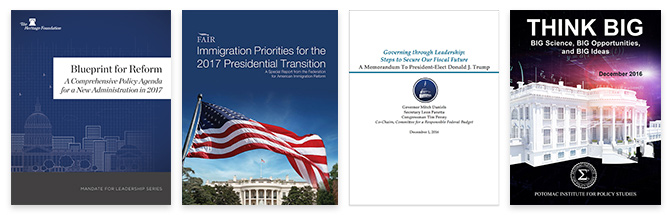
There is also no shortage of advice. Every manner of
constituency, interest
group
and a large number of interested individuals weigh in on policies and
priorities for the new administration.
American Center for Law and Justice
American Hospital Association [PDF]
The American Legion
American Muslim leaders
Ceres
Committee for a Responsible Federal Budget [PDF]
Concord Coalition
Federation for American Immigration Reform
The Heritage Foundation
International Bar Association [PDF]
Journalism associations
Letters from attorneys general on the Clean Power Plan: oppose | support [PDF]
Potomac Institute for Policy Studies
Despite the animosity of the election campaign, the Obama
Administration worked hard to ensure a smooth transition
(+). On
Nov. 10 President
Obama
and President-elect Trump met for an hour and a half in the Oval
Office.
On
Nov. 11 Trump announced that Vice President-elect Mike Pence would
serve as chairman of the Presidential Transition Team, and he
announced co-chairs, executive committee and executive director (+).
There
was
a
lot
of
speculation
about
why
he
had
replaced
Christie,
including
some
speculation
that
Trump's
son-in-law
Jared
Kushner
was
settling
scores.
A
week
later,
on
Nov.
18,
the
transition
office
announced
the
first
of
the
"agency
landing
teams"
which
connected
with
officials
in
various
departments
and
agencies
to
facilitate
the
transfer
of
power
(+).
Trump largely directed transition work from Trump Tower in New
York. He continued to use Twitter to great effect.
On
Nov.
21
he
issued
a
short
video
to
explain
that
his
transition
team was
developing
"a
list
of executive actions we can take on day one
to restore our laws and bring back our jobs (+)."
He
did
not
hold
a
press
conference
until
Jan.
11
(his
previous
press
conference
was
on
July
27
(>)).
In
terms
of
travel,
on
Dec.
1
he
made
a
high-profile
visit
to
the
Carrier
plant
in
Indianapolis;
later
that
day
he
kicked
off
his
"USA
Thank
You
2016"
tour
with
a
campaign-style
rally
in
Cincinnati,
OH
(+).
On
Nov.
17
President-elect
Trump
held
his
first
meeting
with
a
foreign
leader,
sitting
down
with
Japanese
Prime
Minister
Shinzo
Abe,
and
he
engaged
in
many
calls
with
world
leaders.
Trump's
Dec.
2
phone
call
with
president
of
Taiwan
Tsai
Ing-wen
challenged
the
"one-China
policy,"
drawing
a
complaint
from
Beijing.
Trump
also
announced
a
President's
Strategic
and
Policy
Forum to hold
its first meeting in early February (+).
Speculation
in
the
media
about
possible
Cabinet
picks
begins
even
before
Election
Day.
Throughout
November
and
December
the
White
House
staff
and
Cabinet
take
shape.
Typically the president-elect's first announcement is White House
chief of staff,
and
the
first Cabinet pick announced is either
Secretary of State or Secretary of Treasury. Trump led with the
controversial announcement of alt-right aligned Stephen K. Bannon to be
his chief
strategist and senior counselor, balanced by establishment aligned RNC
chairman Reince Priebus
to be his chief of staff. His first Cabinet pick, U.S. Sen. Jeff
Sessions for Attorney General, provoked controversy as did a number of
his other picks. Trump's selection of Secretary of State provided
a
bit of
ongoing drama; many names were floated and the process carried on to
Dec. 13, when the transition office formally announced his selection of
Rex Tillerson, CEO of ExxonMobil. Overall, Trump's Cabinet picks
were conservative, white, male and wealthy and included more people
without government experience than in past administrations (see Building the
Administration).
Incoming administrations take care
to
avoid
early
flaps
which
can
undercut
their effectiveness and
support. Although vetting is intense,
there can be miscues, meaning there may be a nominee or two
who ends up withdrawing
from consideration. The 115th Congress was sworn in on January
3. Senate confirmation
hearings of Cabinet nominees began in relevant committees,
starting with Sen. Jeff Sessions for Attorney General on Jan. 10,
although the U.S. Office of Government Ethics raised concerns that
several nominees had "not completed their ethics review process [PDF]."
The divisions brought out in the campaign had not gone away.
In
the days
after the election, there were hundreds of mostly small, mostly
peaceful protests around the country as well as reports in the media of
increased
harassment, bullying and intimidation of people of color (1, 2, PDF).
Business
matters rose to prominence at several points during the
transition. On Nov. 18 Trump reached a settlement on lawsuits
over
Trump University,
tweeting the next day, "I settled the Trump University lawsuit for a
small fraction of the potential award because as President I have to
focus on our country." In December Trump Hotels in Las Vegas and
Washington reached labor agreements. On Jan. 5 at Trump Tower in
New York Trump
gave a deposition in the case over chef Jose Andres' decision to back
out of a restaurant at the Trump International Hotel in Washington,
DC.
But the broader area of concern was the question of how Trump and
his family would separate his business interests from governing so as
to
avoid conflicts of interest (PDF,
1, PDF2).
On
Nov.
30
Trump
tweeted,
"I
will
be
holding
a
major
news
conference
in
New
York
City
with
my
children
on
December
15
to
discuss
the
fact
that
I
will
be
leaving
my...great
business
in
order
to
fully
focus
on
running
the
country..."
However,
on
Dec.
12
he
pushed
the
event
off
to
"the
near
future."
Trump
finally
held
a
"general
news
conference"
In
New
York
City
on
Jan.
11
where
he
addressed
the
issue,
although
not
to
the
satisfaction
of
critics
(+).
Throughout the transition there were calls for investigations into
Russian interference in the
presidential election (+).
A
first
congressional
hearing
took
place
on
Jan.
5
in
the
U.S.
Senate
Committee
on
Armed
Services,
chaired
by
Sen.
John
McCain.
Meanwhile
on
Dec.
29
President
Obama
announced
"actions
in
response
to
Russian
malicious
cyber
activity
and
harrassment."
The
question
of
whether
there
will
be
an
independent
commission
or
congressional
investigation
remains
to
be
seen.
Trump
appeared
dismiss
the
concerns,
emphasizing
that
"there
was
absolutely
no
effect
on
the
outcome
of
the
election."
Among progressives, seeds of resistance were being sown in planning
for protests of the Inauguration (+).
(Magazine covers told the story as well: The Nation "Mourn, Resist,
Organize," Mother Jones "Rise
Up," and The American Prospect "Resisting
Trump"). Democrats
and
their
allies
likewise vowed
to
hold
Trump
accountable
(+).
The transition is not
only the beginning of a new administration, but the end of an old
one.
Handing over the reins of power requires considerable preparation on
the side of the outgoing administration. The new team must be
briefed; records must be boxed and filed. During its waning days,
the
outgoing administration will also endeavor to get as much done as
possible,
attempting to produce some last accomplishments to add to its legacy
and making a
final round of appointments, executive orders, regulations, and
pardons. President Obama gave his farewell address
in Chicago on Jan. 10, discussing "the state of our democracy" and a
number of threats to it and declaring himself "even more optimistic
about
this country than when we started" (+).
Much attention is given to the first 100 days. One
hundred is a nice round mumber, but it is arbitrary. The original first
100
days refers to the start of President Franklin Delano Roosevelt's
tenure in 1933 during the Great Depression (>), and
100
days continues to be used as a convenient marker to measure a
president's early progress. Just as one cannot judge how a runner
will perform in a marathon from the first two miles, one should not
draw too many conclusions about a
term of 1,461 days from the first 100 days. Six months provides a
better marker. Nonetheless
the early actions of a new administration are fraught with symbolism
and
can give
a sense of how it will operate.
As with his predecessors, Trump has used executive
orders and presidential memoranda to get his administration off to a
start (+)
and
to fulfill campaign promises. Some of these have been quite
controversial, most notably the immigration ban he signed on Jan.
27 and re-issued in revised form on March 6. Trump's nomination
of Neil Gorsuch to the
Supreme Court
was greeted warmly by his supporters.
Trump's Cabinet picks were confirmed without too much
trouble, but there were a few exceptions. The most contentious of
his nominees were
Andy Puzder, who eventually withdrew from consideration as Secretary of
Labor, Betsy DeVos as Secretary of Education, and Scott Pruitt as EPA
Administrator. USTR nominee Robert Lighthizer was the
final Cabinet nominee approved, on May 11. Each
nominee has a team to guide him or her through the
confirmation process; there are policy, legal, press and congressional
affairs aspects to consider. Traditionally the Senate will not
block a nominee unless he or she has ethical problems or is not
qualified. While the nominees go
through the confirmation
process, the work of the departments and agencies goes on under the
direction of
acting secretaries and leadership (PDF).
The
Cabinet
is
only
a
small
part
of
the
work
of
building
an
administration
(1, 2).
All
told,
according
to
the
Partnership
for
Public
Service,
there
are
about
4,100
positions
to
fill,
including
roughly
1,200
positions
requiring
Senate
confirmation.
From the outset the new administration had an antagonistic relationship with mainstream media. At his Jan. 12 press conference Trump dismissed CNN as "fake news." On Jan. 22 senior advisor Kellyanne Conway coined the term "alternative facts" while defending press secretary Sean Spicer. Senior advisor Steve Bannon declared in an interview that, "The media here is the opposition party. They don’t understand this country. They still do not understand why Donald Trump is the president of the United States." Speaking at CPAC on Feb. 24, Bannon described a "corporatist, globalist media that are adamantly opposed, adamantly opposed to an economic nationalist agenda like Donald Trump has."
Many Firsts
The beginning of any
administration is a time of many firsts. Some of President
Trump's
firsts include:
First Day - Jan. 20:
Between the Inaugural Parade and Balls, President Trump signed an
executive order "Minimizing the Economic Burden of the Patient
Protection and Affordable Care Act Pending Repeal," and he signed
commissions of Mattis as Defense Secretary and Kelly as Homeland
Security Secretary (they were confirmed earlier by the Senate, and
sworn in later by Vice President Pence). Chief of staff Priebus
issued a memo ordering an immediate regulatory freeze.
First Trip - Jan. 21:
Trump visited CIA headquarters in Langley, VA, where he spoke for about
15 minutes to 400 employees.
First Meeting with a Foreign
Leader - Jan. 27: Trump met with British Prime Minister
Teresa May in Washington.
First Week - The
Administration touted a "week of action" including 15 presidential
actions directed towards fulfilling campaign promises (+). However, critics
found much to
criticize, whether it was Trump's seeming preoccupation with size of
the crowd at his inauguration or his call for a major investigation
into voter fraud based on the thinnest of evidence or his controversial
executive
order on refugees.
First Combat Operation - Jan.
29: Trump ordered a raid in the Yakla region of Yemen, targeting
al-Qaeda in the Arabian Peninsula. Many questions were raised
about both the planning and the outcome of the raid, which cost the
life of U.S. Navy SEAL William "Ryan" Owens as well as lives of Yemeni
civilians. Trump went to Dover AFP for the arrival of Owens'
remains on Feb. 1, and highlighted Owens' sacrifice in his Feb. 28
speech to Congress.
First Supreme Court
Nomination - Jan. 31: Following the death of Supreme Court
Justice Antonin Scalia in Feb. 2016, President Obama had on Mar. 26
nominated Judge Merrick Garland. However, Senate Republicans sat
on the nomination, leaving an opening for President Trump. Indeed
filling Supreme Court vacancies was one of the issues that helped tip
the election to Trump. On Jan. 31 Trump announced his pick of
Judge Neil Gorsuch, setting off a contentious confirmation
battle (+).
First Solo News Conference -
Feb. 16: Trump announced Alexander Acosta as his new pick for
Labor Secretary and took questions (>).
He
again
lambasted
the
media
and
declared
his
administration
"is
running
like
a
fine-tuned
machine."
First Address to Joint
Session of Congress - Feb. 28: Observers generally lauded
Trump's hour-long address for its conventional tone. "What we are
witnessing today is the renewal of the American spirit," Trump
declared, "Our allies will find that America is once again ready
to lead (+)."
First Big Legislative Battle:
The American Health Care Act (AHCA), a House bill to repeal and replace
Obamacare, marked a
key test for
Republicans, who have sought for years to repeal the Affordable Care
Act.
While Trump and Speaker Ryan worked hard to move the legislation,
labeled by some as "Trumpcare," members of the
House Freedom Caucus and conservatives were skeptical of "Obamacare
lite." The vote was initially set
for Mar. 23 and then postponed to Mar. 24. On the afternoon of
Mar. 24, shortly before the vote was to occur, Ryan pulled the bill (+, *).
[2008
| 2000]
While news organizations ran many critical stories about
Trump and his administration during the first 100 days, during that
same time, through appointments and lack of appointments, executive
orders, and memoranda, the
administration was making strides toward what senior advisor Steve
Bannon termed in Feb. 24 remarks at CPAC "deconstruction of the
administrative state."
High on Trump's accomplishments was the confirmation of Neil
Gorsuch as an Associate Justice of the Supreme Court approved in a
Senate's vote on April 7. The Senate
Judiciary Committee held four days of hearings, Mar. 20-23 (>),
then
voted
on
April
3
in
a
party
line
vote,
11
to
9,
to
send
the
nomination
on
to
the
full
Senate.
Democrats
mounted
a
filibuster,
but
Republicans
turned
to
the
so-called
"nuclear
option,"
requiring
only
a
simple
majority
to
break
the
filibuster
and
approve
the
nomination.
Repeal and replacement of the
Affordable Care Act (Obamacare) proved to be a more
complicated
challenge for the administration due to divisions among congressional
Republicans. Other setbacks came as federal judges blocked
executive orders on a travel ban and sanctuary citles.
Nonetheless the
administration plowed ahead with its agenda. On April 26, with
the 100 day milestone fast approaching, the administration announced a
"massive tax cut" proposal or tax
reform principles, but this was thin on detail and its prospects
uncertain (+).
On
the
international
front,
one
of
the
biggest
developments
of
Trump's
first
100
days
was
his
decision
on
April
6
to
order
a
missile
strike
in
Syria
following
a
chemical
weapons
attack
there
(+).
Also
in
April the U.S. dropped the "mother of all bombs" on
Afghanistan. Heightened tensions with North Korea loomed as a
potential trouble spot.
Questions about Russian interference in the 2016 presidential
election
continued to dog the Trump Administration during its first hundred
days, allthough Trump dismissed the matter as "a ruse" and
congressional investigations seemed to be making little headway (+).
Trump's proclivity for setting off controversies and distractions
continued. For example on March 4 he tweeted, "Terrible! Just
found out that Obama
had my 'wires tapped' in Trump Tower just before the victory. Nothing
found. This is McCarthyism!" However, he provided no
evidence. Media and pundits ran with this story for weeks.
There were reports of bitter infighting in the administration, Trump's job approval ratings were abysmal (>), and critics continued to raise questions about conflicts of interest and whether Trump and his family were profiting from his presidency (+). Opponents ("the resistance") continued to organize and protest. Any hopes that Trump, as an outsider, might be able to break the gridlock on Capitol Hill quickly fell by the wayside (+). Trump's supporters largely continued to back him, although a number of articles appeared suggesting he was straying from the populist and non-interventionist themes he espoused during his campaign.
In his weekly radio address Trump termed his first 100 days "just
about
the most
successful in our country’s history" stating that, "In just fourteen
weeks my administration has brought profound change to Washington (+)."
However, many media reviews were scathing.
Matt Bai characterized the administration as "Team of Amateurs" and the New Yorker's John Cassidy wrote
that "it often looks like the Keystone Kops are in charge."
The Washington Post tallied
488 false or misleading claims by Trump in his first 100 days (>).
Writing
in
the
Weekly Standard,
Michael
Warren
described
an "ad hoc presidency."
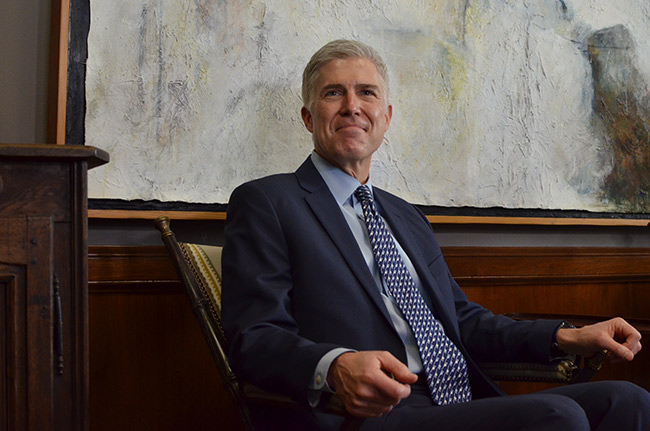
Feb.
2
-
Supreme
Court
nominee
Neil
Gorsuch
on
Capitol
Hill. +
Typically
the leadership of both national party committees changes after a
presidential election.
The president-elect will select the chairman of his or her
party. For the losing side, a number of hopefuls compete to
rebuild
the party, and there is much discussion about how to move beyond the
recent defeat. In December 2012, RNC chairman
Reince
Priebus announced a Growth & Opportunity Project "to
grow the Republican Party and improve future Republican
campaigns." A 98-page report containing 219 recommendations was
released on March 18, 2013 (+).
During the 2016 campaign
there was a lot of talk about how Trump's ascendancy marked the end of
the Republican Party (+),
but following the campaign it was
the Democrats who had to figure out what went wrong and how to fix
it. Part of that discussion centers on who should be the next
chairman of the DNC. Seven major candidates and several lesser
known candidates ran:




- U.S. Rep.
Keith Ellison (MN) started his campaign early and appeared to be
the
favorite. He gained the
support of such progressive
luminaries
as Sen. Elizabeth Warren (MA) and Sen. Bernie Sanders (I-VT), the
backing of
the AFL-CIO and other unions, and tallied numerous endorsements (+).
- South Carolina Democratic Party
chair Jaime Harrison announced his bid
on Nov. 14, stating that Democrats "must reach out to every state,
every community, and every voter (+)."
...withdrew
on
Feb.
23
and
endorsed
Tom
Perez
- New Hampshire
Democratic Party chair Ray Buckley announced on
Nov. 29,
vowing "radical reform of how the DNC operates (+)."
Buckley has served as a DNC vice chair and president of the Association
of State Democratic Chairs (ASDC) since Jan. 2009, as state chair for
close to a decade and a leading gay
activist within the party. He is a veteran of Democratic
politics,
having started as a volunteer for Ed Muskie at age 12. ...withdrew on
Feb. 18 and endorsed Keith Ellison
- U.S. Secretary of Labor Tom Perez
announced his candidacy on
Dec. 15. Perez was seen as President Obama's choice. He
described himself as a "turnaround specialist" and emphasized that
"most of all, we need to listen (+)."
- Idaho Democratic Party executive
director Sally Boynton Brown announced her candidacy on Dec. 16,
seeking to build "a resilient, innovative Party for the 21st
century."
She is president of the Association of State Democratic Party Executive
Directors (ASDED) (+).
- South Bend Mayor Pete Buttigieg
offered a "fresh start," declaring "the solutions for our party won't
come from Washington, they'll come from our communities."
Buttigieg announced on Jan. 5. He is a Rhodes scholar,
Afghanistan veteran, and gay and is still under 40
years old (+).
- Jehmu Greene, whose
experience includes serving as president of Rock the Vote from 2000-05
and a political analyst on the FOX News Channel since 2010, was the
final entrant in the field and said she would be a "fierce messenger"
for the party.
Former
Gov. Howard Dean was in the running for a short time but ended his bid
on
Dec.
2. Former Gov.
Martin O'Malley
and NARAL Pro-Choice America president Ilyse Hogue also looked at
running but ruled it out.
The rules and
procedures for the election [PDF] were set by the
DNC Rules and
Bylaws Committee at
their meeting in Denver, CO on Dec. 1-3, 2016. A series of forums was held,
and
the
election
itself took place at the DNC winter meeting in Atlanta, GA on Feb. 25,
2017 [PDF].
Tom
Perez
came
up
just
short
on
the
first
ballot
ahead
of
Keith
Ellison,
and
then
won
on
the
second
ballot
(+).
At
the
meeting there was also heated debate over a resolution to ban
contributions
from corporate PACs. None of the party officers is a straight
white male and early signs are the party is continuing its emphasis on
diversity (+).
Another issue for Democrats
is the question
of super-delegates;
the
DNC
Rules
Committee,
meeting
in July 2016 during the Democratic National Convention,
established a "unity commission" which will address that point and
possibly other issues. The party announced the 21 members of the
Commision on April 17 (+).
Meanwhile, the RNC named
its leadership for 2017 as Michigan Republican
Party chairwoman Ronna McDaniel and Trump for
President Ohio state director Bob Paduchik (+).
Additionally on Jan. 12, 2017 Trump announced a small leadership team
for his re-election campaign (+), and
on Jan. 20 he filed a Form 2 with the FEC.
The campaign did not stop (+).
Also in January several
outside groups took up the task of supporting President Trump's
agenda. Great America Alliance grew out of a super PAC that was
active during the campaign (+), while
on
Jan. 30 Trump-Pence leaders launched another group, America First
Policies (+).
Notes.
1. On Oct. 16, 2010, President Obama signed
into law
S.3196, the Pre-Election
Presidential
Transition Act of 2010, providing for the General Service
Administration to provide for transition planning resources starting
after the nominating conventions. Sen. Ted Kaufman (D-DE) and
several other Senators introduced the bill in April 2010 (+),
based on recommendations in a report from the Partnership for Public
Service.
2. On Aug. 10, 2012, President Obama signed into law S.679, the Presidential Appointment Efficiency and Streamlining Act of 2011, which reduces the number of executive positions subject to Senate confirmation.
3. The end of Trump's first 100 days seemed to trigger a bump in 2020 speculation:
Chris Cillizza. There are at least 22
Democrats thinking about running for president in 2020. CNN,
May
2,
2016.
Perry Bacon Jr. and Dhrumil Mehta. "The 7
Signs That Someone Might Be Running For President In 2020." FiveThirtyEight,
May
8,
2016.
Lisa Hagen. "The 43 people who might run
against Trump in 2020." The Hill, May 8, 2016.
U.S.
General
Services Administration: Presidential Transition
Office of Personnel Management:
Presidential
Transition
Guide
Partnership for Public Service: Center for Presidential
Transition
U.S. Senate
Committee on Homeland Security and Governmental
Affairs. Dec. 5, 2016. Policy
and
Supporting
Positions.
Washington, DC: U.S.
Government Printing Office. [The Plum Book]
Martha Joynt Kumar. May 2015. BEFORE THE OATH: How George W.
Bush and Barack Obama Managed a Transfer of Power.
Baltimore, MD: Johns
Hopkins
University
Press.
Christopher Liddell, Daniel Kroese and Clark Campbell. May 1, 2013. ROMNEY READINESS PROJECT 2012: Retrospective & Lessons Learned. R2P, Inc..
--. Jan. 13, 2010. READY TO GOVERN: Improving the Presidential Transition. Washington, DC: Partnership for Public Service.
Anne Joseph O’Connell. Jan. 15,
2009. LET'S GET IT
STARTED: What President-Elect Obama Can Learn from Previous
Administrations in Making Political Appointments.
Washington, DC: Center
for
American
Progress.
Stephen
Hess. Nov. 2008. WHAT
DO
WE
DO
NOW?:
A
Workbook
for
the
President-elect. Washington, DC: Brookings
Institution
Press.
L. Elaine Halchin. Nov. 25, 2008 update. "PRESIDENTIAL TRANSITIONS: Issues Involving Outgoing and Incoming Administrations." Washington, DC: Congressional Research Service.
U.S. Senate. Sept. 10, 2008. "Managing the Challenges of the Federal Government Transition." Hearing before the U.S. Senate Committee on Homeland Security and Governmental Affairs, Subcommittee on Oversight of Government Management, the Federal Workforce, and the District of Columbia.
U.S. General Accountability Office. June 2002. THE WHITE HOUSE: Allegations of Damage During the 2001 Presidential Transition (GAO-02-360).
Martha Joynt Kumar and Terry
Sullivan , eds. Feb. 2003. THE WHITE HOUSE WORLD:
Transitions, Organization, and Office Operations (Joseph V.
Hughes, Jr., and Holly O. Hughes Series in the Presidency and
Leadership Studies, No. 13). Texas A&M University Press.
Richard E. Neustadt. Oct.
2000. PREPARING TO BE
PRESIDENT: The Memos of Richard E. Neustadt. AEI Press.
John P.
Burke. Sept.
2000. PRESIDENTIAL
TRANSITIONS: From Politics to Practice. Lynne Rienner
Publishers.
Carl M. Brauer. Dec. 1988. PRESIDENTIAL TRANSITIONS: Eisenhower through Reagan. Oxford University Press.
