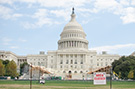
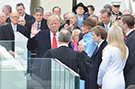
Inaugural ceremonies mark the peaceful transfer of power. Inaugurals are a time of hope, of reflection on where our country stands, and of celebration. Shortly before noon on January 20, 2017, in a ceremony at the Capitol, President-elect Donald Trump swore the oath of office, becoming the 45th president of the United States. He delivered his inaugural address and set to work at governing.
58th Presidential Inaugural: "Make America Great Again!"
Donald Trump ran a
decidedly non-conventional campaign and observers expected that his
inaugural ceremonies, while featuring many basic elements could also
include non-conventional aspects. The
inaugural
theme
continued
on
from
the
campaign:
"Make
America
Great
Again!" According to PIC
chairman Tom Barrack, “The 2017 inaugural celebrations will reflect
President-elect Trump’s eagerness to get to work in order to make our
country safer and stronger (+).”
|
Schedule of Events
Thursday, January 19, 2017 Wreath
Laying
Ceremony
Arlington
National
Cemetery
Lincoln
Memorial
|
|
Friday, January 20, 2017
Pennsylvania
Avenue
Liberty and Freedom:
The Official Presidential Inaugural Balls
Washington Convention Center Salute to Our Armed Services Ball National Building Museum |
|
Saturday, January 21, 2017
National
Prayer
Service
Washington
National
Cathedral
|
Organizing
the
Inaugural
Activities
Every four years three committees form to organize
the
inaugural activities.
The Joint Task
Force-National Capital
Region (JTR-NCR), a joint task force of the five Armed
Forces branches, is
"charged with coordinating all military ceremonial participation and
support" for the presidential inauguration. (Prior to the 2013
inauguration JTR-NCR was known as the Armed Forces Inaugural Committee
or AFIC). For the
January 2017 inaugural ceremonies, U.S. Army Maj. Gen. Bradley Becker
is the commander of JTF-NCR (+).
Eight-hundred-and-twenty service personnel, including
full-time (PCS/permanent change of station) and personnel on temporary
duty, are authorized to work on the task force. Including the
parade and
ceremonial
support some 5,000 service members will participate in the
Inauguration (+).
Additionally, the National Guard plays an important role in traffic
control and crowd management.
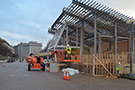
The Joint Congressional Committee on Inaugural Ceremonies (JCCIC) is responsible for all events held at the Capitol (+). The JCCIC is a committee, established by a congressional resolution, consisting of six leaders of the House and Senate. For the 2017 inaugural, Sen. Roy Blunt (R-MO) is chairing the JCCIC. The JCCIC held its organizational meeting on April 13, 2016, and did the first nail ceremony, marking the start of construction of the inaugural platform on Sept. 21. The FY2016 Legislative Branch Appropriations Bill funds the JCCIC at $1.25 million and "provides funding for the Inaugural stands and support facilities within the Architect of the Capitol budget; and includes associated overtime and security costs within the Capitol Police budget."
The final piece is the Presidential
Inaugural
Committee
(PIC), charged
with organizing events for the Inaugural. A PIC is formed every
four years
after the general election and must accomplish most of its work in a
period of just two months. On Nov. 15 President-elect Trump
announced leadership of the 58th Presidential Inaugural Committee,
headed by chairman Thomas J. Barrack (+).
Sara
Armstrong served as CEO (+), and
there were about 400 people working on the committee.
Many campaign operatives end up working for the
PIC. The
PIC
raises
funds
from
donations.
(The 2013 PIC reported net donations of $43.8 million. The
2009 PIC reported net donations totaling $53.2 million).
The PIC sets an inaugural theme, in this case "Make America Great Again!" Past themes have included: "Our People, Our Future" (2013), "Renewing America's Promise" (2009), "Celebrating Freedom-Honoring Service" (2005), and "Celebrating America's Spirit Together" (2001). Signature events of both of President Obama's inaugurals were a day of service. Other high-profile publicized events include concerts and inaugural balls. The PIC may also put together a few more limited events such as receptions or dinners for donors and supporters or a staff ball. This 2017 PIC reportedly had trouble finding entertainers willing to participate in events and produced few events.
In addition to the PIC, JCCIC
and JTF-NCR, numerous agencies coordinate on security for the events
of
inaugural week. Because the Department of Homeland Security
designates presidential inaugurals as National Special Security
Events (NSSEs), the U.S. Secret Service is the lead agency (+).
For
the
2013
inaugural,
the
Secret
Service
established
a
Presidential
Inaugural
Multi-Agency
Communications
Center
which
hosted
"representatives
from 42 agencies, including law enforcement, utility companies, transit
authorities, and the military."
Complementing the official activities, state societies, interest
groups
and other organizations host inaugural
balls
and
events around Washington, DC.
News organizations devote significant planning and resources to
bringing coverage of the inaugural festivities to their
audiences (+).
The
hundreds
of
thousands
of
people
who
travel
to
the
capital
for
the
ceremonies
challenge
transportation
and
communication
services
but
also
boost
area
hotels and businesses.
Trump set off a bit of
controversy over crowd estimates for his
inauguration; crowds were significant, but did not match the Obama
record from January 2009. In January 2013, following Obama's
re-election, more than 800,000 and possibly as
many as one
million people attended the ceremonies.