
In the general election, a number of landmarks lead the way to Election Day: the traditional Labor Day kick-off, the ad campaign, September debate negotiations, the debates themselves, and a grueling last ditch effort as the candidates go all out to win over a few more voters in key states. Charges and countercharges fly; excitement builds. While all this is happening, the campaigns are operating with one goal in mind: 270. Two hundred-and-seventy electoral votes is the number needed to win, and major party presidential campaigns deploy their resources accordingly.
Contrasting Visions or Chasing Dollars and Trivial
Pursuit?
Ideally the general election campaign would provide a stage for discussion of the major challenges facing the country and for presentation of competing approaches and ideas for addressing those challenges. The candidates would set out their priorities and give a sense of how they would govern. An effective general election campaign not only gets the candidate elected, but sets him or her on a path to governing.
In reality, however, the fall
campaign is oftentimes not particularly edifying. First of all,
the candidates do spend quite a bit of time fundraising.
Secondly, it
is a lot easier to resort to familiar bromides than to address
complicated issues such as entitlement reform or income
stagnation. In the general election Trump continued to rally
under the banner of "Make America Great AgainTM"
(#MAGA)
(>)
while Clinton advanced a "Stronger Together" theme (which many pundits
derided after the campaign).
Much attention in the general election
is devoted to defining the opponent in unfavorable terms. Charges
and countercharges fly. Seemingly trivial episodes, incidents
and gaffes are elevated by the campaigns and the media, while major
issues go
unaddressed. One recalls the hubbub around Mitt Romney's "47-percent"
remarks
in the 2012 campaign or George H.W. Bush's attacks on Michael Dukakis
as a "card-carrying member of the ACLU" in the 1988 campaign.
2016 revolved around a never ending series of Trump
controversies. Clinton and her campaign sought to portray Trump
as unfit and dangerous, while Trump and his campaign daily prosecuted
the case against "Crooked Hillary." As expected, the Republican
campaign also suggested that the
Democrat ticket would amount to a third term of the Obama
administration, while the Democratic campaign suggested
that the
Republican ticket was extremist and would take the country backwards.
General Election Campaign Gets
Underway
In a real sense the
general
election begins once it is clear who the major party nominees will be;
for both parties that will in all probability occur well before their
respective
national nominating conventions. Once they have garnered enough
delegates to secure their nominations, the
presumptive
nominees
turn their attention away from the primary campaigns to the general
election
and the goal of obtaining 270
electoral votes in November. Major party nominees may move toward
the middle, toning down
more extreme elements of their messages that they had used to appeal to
party activists during the primaries.
The campaigns start to add staff and
advisors, place a few top people at
the national party committees and build out organizations in key
states. The addition of the running
mates give the
campaigns another way to get out their messages. The national
convention makes the
nomination official and, if all goes well, provides a "bounce" for the
ticket. For 2016 RNC
chairman
Reince Priebus determined to hold the GOP convention considerably
earlier than in recent cycles and the Democrats followed suit.
The Democratic Convention concluded on the evening of July 28, leaving
just over 100
days of fully engaged campaigning until Election Day.
Battleground/Swing States and Other States
A campaign
must determine how best to spend the resources it has available; these
include staff, advertising, and candidate and surrogate visits.
In some states the
campaign
will "play hard" or even "play very hard." These contested states
receive frequent visits by the candidate, his or her spouse, the vice
presidential
candidate, and surrogates, and the campaign makes serious ad buys in
them.
At the other extreme, some states are essentially written off as
unwinnable;
they receive minimal resources. A battleground state is one in
which both campaigns are investing
significant resources (staff, candidate and surrogate visits and
advertising). Recent campaigns have revolved
around
about nine or ten battleground
states; the list can vary over time and depending upon to whom one is
talking.
As the weeks progress, a campaign may upgrade or downgrade a state's importance as it becomes more or less competitive. A campaign needs to have devised several "paths to 270" in the event that some of its states do not gel as the campaign draws to a close. In Fall 2016 Democrats sought to expand the map, making investments in Arizona, Georgia and Utah (GA, UT, AZ also TX). Arizona drew particular attention; both Hillary Clinton and Tim Kaine visited Arizona in the final week. Meanwhile, the Trump campaign pushed into Michigan and New Mexico, pressed in Colorado, Wisconsin and Virginia, even ventured into Minnesota, and continued to focus much resources on Pennsylvania (+).
| June | July | Aug. | Sept. | Oct. | Nov. | By State |
||
| Former Sec. of State Hillary Clinton |
x | x | >> | |||||
| Donald Trump |
x |
x | >> | |||||
| Sen. Tim Kaine |
||||||||
| Gov. Mike
Pence |
||||||||
| Former Gov. Gary Johnson |
x |
x | x | x | ||||
| Dr.
Jill
Stein |
x |
x | x | x | ||||
| also Bill, Chelsea,
Obama/Biden |
||||||||
| Rationale,
Methodology
and
Limitations |
map |
| Selected
states
in
detal: AZ | CA | CO DC FL GA IL IA ME MA MI MN MO NV NH NY NC OH PA TX VA | WI |
| April | May | June | July | Aug. | Sept. | Oct. | Nov. | By State |
||
| Pres.
Barack Obama |
x | x |
x | x | x |
> | ||||
| First
Lady
Michelle
Obama |
x | x |
x | x | x |
> | ||||
| Vice President Joe Biden | x | x |
x | x | x |
> | ||||
| Former Gov. Mitt Romney | x |
x | x | x |
||||||
| Ann Romney | x |
x | x |
> | ||||||
| Rep. Paul Ryan | |
|
|
|
x |
x | x | x |
> |
|
| Gary
Johnson
|
x |
x |
x |
x | x | x |
||||
| Jill Stein | |
|
|
x |
x |
x |
x | x |
|
|
| Rationale, Methodology and Limitations | map |
| Selected
states
in
detail: AZ | CA | CO | DC | FL | GA | IL | IA | MA | MI | MN | NV | NH | NJ | NY | NC | OH | PA | TX | VA | WI |
| June | July | Aug. | Sept. | Oct./Nov. | By State |
||
| Sen. John McCain |
x |
|
x |
|
|
> | |
| Gov. Sarah
Palin |
|
x |
|
|
> | ||
| Cindy McCain x |
|||||||
| Todd Palin x | |||||||
| Sen.
Barack Obama |
x |
|
x |
|
|
> |
|
| Sen. Joe
Biden |
. |
x |
|
|
> | ||
| Michelle
Obama |
|
x |
|
|
|||
| Jill
Biden x |
|||||||
| Rationale,
Methodology
and
Limitations |
Ralph Nader |
| Selected states in detail: CO | FL
| IA
| IN
| MI
| MN
| MO
| MT
| NV
| NM
| NC
| OH
| PA
| VA
| WV
| WI More states: CA | NH | NJ | NY | TX | WA |
Base Voters, Mobilizable Voters and
Undecided Voters
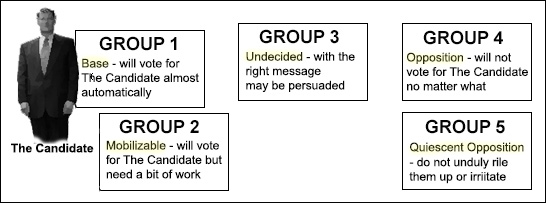
Once a campaign has decided it will contest a particular state, it does not blindly throw resources in. In presidential elections a significant share who turn out will vote for the Republican candidate no matter what and another significant share will vote for the Democrat no matter what. However, while some voters reliably turn out election after election, there are also voters who are clearly partisan in their leanings but do not turn out every election; they need extra motivation and attention. Campaigns have increasingly come to focus on this group, called variously mobilizable, low propensity, low engagement or infrequent voters. Using data and analytics, modeling and micro-targeting, the campaigns can identify these voters and try to motivate them to turn out. Finally, there are the undecided or persuadable voters. The idea is that with the right message the campaign can persuade these voters to support the candidate. Persuadable voters have assumed somewhat mythic status; in Oct. 2012 Slate asked "Dear Undecided Voter: Do You Exist?"
 |
|
| For
a campaign, the electorate can be divided into several groups: (1) the
base, who
are for the candidate almost automatically; (2) mobilizable, low
propensity or low
engagement voters who need more attention; (3) undecided voters who can
be persuaded by the right message; (4) the opposition, who will turn
out against the candidate; and (5) the quiescent opposition, who will
turn out against the candidate if sufficienty riled up. In the
fall, much of the campaign's resources are directed to groups 2 and
3. Then, in the closing weeks, the campaign makes a
substantial
effort to mobilize its base supporters (group 1). Ed. - Note that this model is updated from
past cycles. |
Campaign stops are
scheduled
in media markets with high concentrations of mobilizable or persuadable
voters.
In addition to the candidates themselves, a wide variety of surrogates
trek through, ranging from family members to political figures to minor
celebrities. People in targeted areas and groups can also expect
to see a lot of
political ads and other campaign communications and may find a campaign
office close by. Campaigns also tailor their messages to specific
constituencies through coalition or outreach efforts, seeking to
connect to women, Hispanics, youth and so forth. Further into the
fall newspapers start making endorsements, and the campaigns make sure
to highlight those.
Campaigns must consider not only where and how but when they will
disburse
their resources. Due to increased early
and absentee voting, there is not just one "Election
Day." The beginning of early voting in
those states that have it and later the approach of Election Day prompt
the
campaigns to redouble
their efforts to mobilize
supporters.
Phone-banking and precinct-walking are staples of get-out-the-vote
(GOTV)
efforts.
Although there is a system of federal funding for the
presidential general election, recent campaigns have opted to forego
federal funds so they can raise and spend more money. (The
general election grant, established by the Federal Election Campaign
Act, comes with a spending limit; this started out at $20 million in
1974 and has been adjusted for inflation since). In 2016 both the
Clinton and Trump
campaigns declined the general election grant which would have limited
spending to $96.14 million.
A Campaign Finance Institute summary shows that from July 1-Dec. 30, 2016 the Clinton campaign and joint fundraising committees reported total receipts of $336.3 million compared to $309 million for the Trump campaign and joint fundraising committees. For the entire two-year election cycle the Clinton campaign and joint fundraising committees reported total receipts of $622.2 million, while the Trump campaign and joint fundraising committees reported total receipts of $408.9 million. CFI points out a big difference between how the two raised their money: Trump's "small donor numbers were record shattering." Clinton raised $136.8 million in contributions of $200 or less compared to $238.6 million in contributions of $200 or less for Trump.
In addition to the money raised by the
campaigns, the
national parties are allowed to spend a fixed amount advocating the
election
of their nominees; the limit for coordinated party expenditures in 2016
was $23.8 million (>).
The parties
are also free to make independent expenditures supportive of their
nominees.
However, the campaigns and the parties are not the
only players on
the
field. Super PACs and other outside groups spend tens of millions
of dollars.
Recall that in 2004, Section
527 groups such as America Coming Together and The Media Fund on
the
Democratic side and Progress for America and Swift Boat Vets and POWs
for
Truth on the Republican had a significant impact. In 2008 such
groups were less
of a force. In 2012 outside groups were major players
again. Court rulings in Citizens
United (Jan. 21, 2010) and SpeechNow.org
(March 26, 2010) made super PACs possible, opening up what some
termed a "Wild West" of campaign spending. Super PACs and other
groups weighed in heavily with independent expenditures mostly
attacking the opposing candidate. The main group on the Clinton
side was the Priorities USA Action super PAC, which spent $110.3
million, most of which went to TV advertising. A number of groups
made independent expenditures in support of Trump; the Get Our Jobs
Back Inc. super PAC led the field, reporting spending $50 million (>).
Presidential campaigns have grown increasingly
sophisticated. The 2012
Obama re-election campaign set the standard.
Campaign manager Jim
Messina placed a major emphasis on metrics. "This
campaign has to be metric
driven. We're going to measure every single thing in this
campaign," he stated in an April 2011 campaign video. The
campaign
was constantly modeling and testing. Will this message work with
low engagement voters? Is this person likely to donate? To
volunteer? The reason for this approach was
simple. Data allows the campaign to use its time and money more
wisely. The experience of the Clinton campaign provides a
cautionary note on the limitations of data and analytics. In a
Nov. 9 article, The Washington Post's
John
Wagner
provided
an
overview
of
Ada,
a computer algorithm that "was
said to play a role in virtually every strategic decision Clinton aides
made" (>).
A hallmark of the 2008 and 2012 Obama campaigns was a
massive ground
game with
numerous field offices, field organizers, and volunteer neighborhood
team leaders, which significantly outmatched the organization on the
Republican side.
In 2012 the Obama
campaign had the advantage of building out its organization over a
period
of a year, without facing a primary challenge. Meanwhile, the
Romney campaign went from one
state primary contest to another leaving scant infrastructure, and
it never really caught up on the ground. In Fall of 2016 the
Clinton campaign was significantly better organized in terms of the
number of field offices, but Trump's data operation and use of social
media carried the day.
[On a technical note, the
field organization on the ground in a given state is typically carried
out by a coordinated campaign or Victory campaign which is funded by
the
state party and the national party and seeks to elect party officials
up
and down the ticket].
Much of the money raised by the campaigns goes into paid media, particularly television advertising. The campaigns are also giving more and more attention and resources to online advertising as well as advertising on social media. Running a pre-video ad on YouTube or a banner ad on the local newspaper's website can be a very effective way to reach a specific demographic group in a particular state. Radio is an effective way to reach some audiences, for example during drive-time. Because of its lower profile radio is sometimes used to deliver negative messages. Persuasion mail and phone calls also convey the campaigns' negative messages. Magazine and newspaper advertising can be very effective, but are not used much.
Traditionally campaigns have
put
together ad
teams
which
includes
both
political
and
Madison
Avenue
talent.
Based
on
polling
data,
the
themes
the
campaign
wants
to
stress
will
have
been
identified.
The
ad
team
generates
ideas
to
convey
those
themes,
and
produces
spots
which
are
then
tested
in
focus
groups,
and,
hopefully,
approved
by
the
campaign
management.
However,
the
work
does
not
stop
with
an
ad
"in
the
can"
and
approved;
careful
planning
is
required
to
ensure
that
the
ads
are
seen
by
the
target
audience.
The
demographic
watching
"60
Minutes"
differs
markedly
from
that
watching
"Judge
Judy."
It
is
left
to
media
planners,
juggling
GRPs
and
dayparts,
to
put
together
ad
buys.
Similarly, for online advertising digital ad buyers try to reserve
premium spaces. In
addition
to
ads
from
campaigns,
super
PACs and
interest groups add their voices to the mix.
While paid media has long drawn attention because of
the amount of
resources devoted to it and because it can be relatively easy to
identify ("Paid for by...), campaigns also strive for earned media and
social media buzz. Earned media means the campaign does an event
that makes the national news or the front page of the newspaper.
Trump through his use of Twitter and the constant controversies
surrounding him excelled in earned media.
Social media is a still evolving area that has great
potential. If a
friend or acquaintance sends you a message saying, "Hey, look at this
interesting graphic or video from the X campaign," that is likely to
have more
impact than an impersonal message. The campaigns have staff busy
tweeting, posting on Facebook, developing infographics and sending out
emails. While the scope and effectiveness of these efforts is
difficult
for outside
observers to
assess, observers point to the Trump campaign's use of data and social
media as a key element of its success.
The 2016 presidential campaign may not have been the
worst in American history, for there were some fairly dirty campaigns
in the 19th century, but it was a nasty affair. Clinton and Trump
were two of the most unpopular nominees in decades. It was
"Crooked Hillary" and the dangerous, unfit Donald Trump. At the
close of the campaign the RealClearPolitics poll average put Trump at
58.5 percent unfavorable, 37.5 percent favorable (+21.0) Clinton at
54.4 percent unfavorable, 41.8 favorable (+12.6). Trump's
continual insults and denigrations of individuals and groups set a tone
(+).
At the same time Trump appeared disinterested in the nuances of policy,
instead repeating the same slogans and catch phrases at rally after
rally throughout the campaign. Too often the discourse focused on
the latest Trump controversy rather than the clash of
ideas. Many Trump supporters viewed Clinton as a criminal
and wanted to "lock her up," while Clinton saw many of the Trump
supporters as "basket of deplorables" who were "irredeemable." On
top of the flawed candidates, a broken campaign finance system did not
help matters. The Campaign Legal Center charged that "the
campaigns of the
presidential candidate of both major parties are involved in
unprecedented coordination with super PACs in violation of the law (+)".
On top of that the candidates, particulary the Democratic team, spent
substantial time in exclusive closed door fundraisers rather than
meeting with ordinary voters. Little wonder that more than half
of American adults viewed the
presidential election as a significant source of stress (+).
